
The International Canoe started life as a regular paddling canoe prior to the 1860s. In 1884 international competition began between the English and the American's for the New York Canoe Club International Cup, sails were raised when the wind was up. (This cup is the second oldest trophy in sports, the America's Cup being the oldest, and is still competed for today.) In the 1880's the American's took to sitting on the sides of their canoes when racing or even sitting on planks out the side of the canoe and the turn of the century saw many advancements in technology such as clutch cleats, pivoting centreboards, and under body rudders.
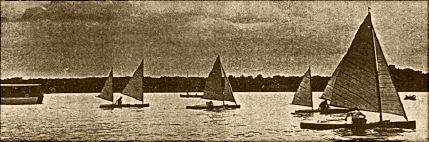
As the years passed this spirit of international competition and development has permeated the class, resulting in some interesting historical footnotes. Both the rig and hull saw considerable development until, to limit costs and promote the class, hull development was suspended in 1971. The rules remain open to this day, exemplified by the recent incorporation of asymmetrical spinnakers, and continued rig and foil development.*
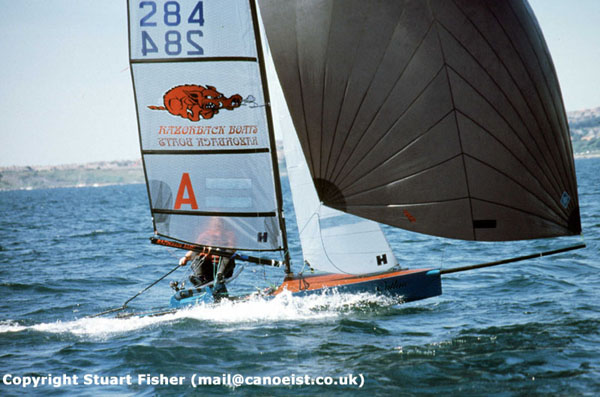
A prime example of this in recent years is the development of the asymmetrical spinnaker equipped International Canoe (or AC for short) flying a 22 m^2 asymmetrical spinnaker. The IC has a Portsmouth number of 908 putting it on par with the 505 (902), and 29er (924) classes (both double-handed). The AC has a provisional Portsmouth number of 868 putting it on par with the I14 (864) and the RS700 (858, slightly faster) though the AC continues to evolve. This is exceptional considering that all these other boats with the exception of the RS700 are double-handed.
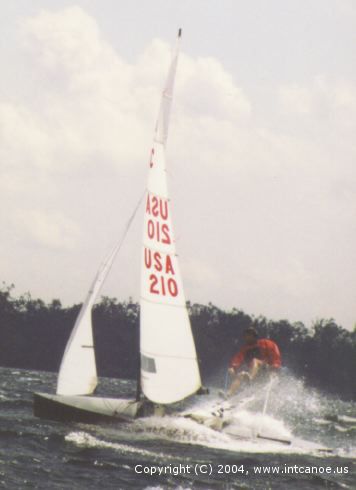
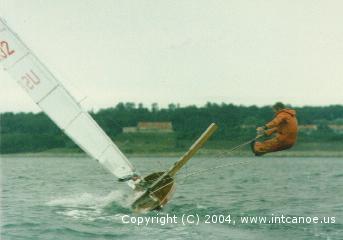
* from "The development of International Canoes" at www.intcanoe.org. Check the site out for pictures, forums, and a detailed history of the development of the sailing canoe.