
Planning
Planning the construction of this boat is a bit of a joke amongst the people I know since its taken me the better part of 5 years to get it done. The actual construction was supposed to take a year, but last spring I separated my shoulder and wasn't able to work on the boat until the fall. If I was ordering the spars from someone this boat probably would have taken a winter to build, though it would have been tight and I would need to have started in September.
Given the nature of this endeavour a garage or workshop is needed. Since I don't have one I had to rent a garage. This has ended up being a significant expense as the work stretched out. When I buy a house a large workshop is definitely a priority.
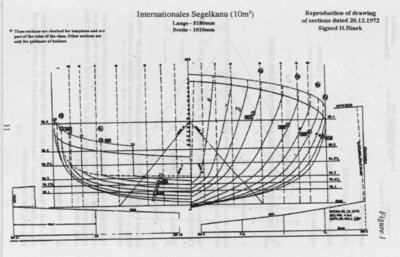
My plans for the boat were obtained from Martin Herbert and look somewhat like the image below. A set of these plans can be obtained from Mystic Seaport Marine Museum for roughly $50US. Its catalogue #29.157 and includes:
- profile and deck plan
- construction plan
- partial lines plan with hull sections and bow and stern shapes
You can contact them for current prices and ordering information:
Ships Plans Library
MYSTIC SEAPORT
Museum of America and the Sea
75 Greenmanville Avenue
PO Box 6000
Mystic, CT 06355-0990 USA
tel: 860.572.5360
fax: 860.572.5371
shipsplans@mysticseaport.org
www.mysticseaport.org
www.mysticseaport.org/library/collections/ships.cfm
Combining these with a set of the rules [.pdf] gives you the outline of what must be done. The latest set of rules can be obtained from the International Canoe site.
I was able to obtain a mold for the hull from Martin. This saved me the time and trouble of building one from the plans, which can take twice as long as the hull to make, and removed a lot of the worries about making a boat that will measure to the rules.
Materials
The materials chosen for this project are the result of a fair bit of reading.
Wood
For the structure of the boat I used Sitka Spruce. Sitka is extremely strong and solid and widely used in boat building.
For the skin I used two layers of Meranti plywood cut into 2 inch strips. Meranti is less common, with most boat builders defaulting to construction with Marine Occume (African Mahogany) or Cedar. Meranti is very similar to Occume and Cedar but stronger and absorbs less epoxy. This results in a slightly lighter, less expensive boat. (Epoxy is expensive in weight and cost compared to wood.)
The core of the daggerboard and rudder were made with White Poplar. Poplar is a replacement for Red Cedar or Spruce, recommended widely for the core material of foils. Poplar has almost identical physical properties to Red Cedar with respect to strength and flex. A foam core was considered, but to achieve a useful strength, the foam core has to be nearly the same density as the wood. Commonly used foams for the core are Klegecell and Divinicell - don't use standard polystyrene unless you are aiming for a spectacular failure. Foam's main advantage is uniformity throughout the foam block, which is balanced against the significant additional cost, since Poplar is so cheap.
For finding out about the properties of wood I've found WoodPro to be very helpful. WoodPro is an old DOS program that has a huge database of wood types and their properties. Its great for selecting what sort of wood to use or finding a replacement for something you can't find. There's more information here and a local copy of the program is here, should that link stop working.
Composites
Carbon fibre, kevlar and fibreglass are the name of the game for masts and booms. These are constructed around a foam core, then vacuum bagged to remove the excess resin and achieve a strong light spar.
These materials each have their strengths. Carbon fibre is very strong overall but has low strength for point loads (where all the weight is at one point). Kevlar provides little strength but good ability to resist abrasion and point loads. Fibreglass provides little strength compared to carbon fibre and so is mainly used as an inner or outer skin that can be sanded down and smoothed. (Sanding carbon fibre is nasty and wasteful, sanding kevlar just makes a mess since the kevlar fibres fuzz out.) Foam is used as a mold but the foam I've used has almost no structural value, so has been removed when the layup is completed.
Hardware
The hardware is largely Harken, but Ronstan, Holt, and Proctor parts are used as well. I really like the new carbon blocks that have come out in the last few years, so I've made extensive use of them.
There's plenty of stainless steel screws and fittings strewn about the boat as well. Aluminium parts were avoided since the carbon in carbon fibre reacts with aluminium in bad ways to weaken the carbon fibre.