
Why should I take up sailing the fastest one person mono hull in the world?
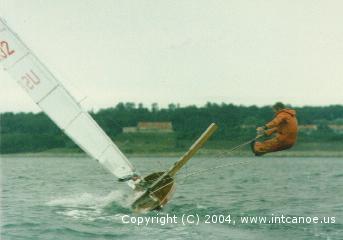 Because
its like a kick in the pants. Its a wild and exhilarating experience.
Because
its like a kick in the pants. Its a wild and exhilarating experience.
How's that seat work?
The seat was developed around 1900 to do what the trapeze does in newer classes of sailboats. It provides more force to keep the boat flat in stronger wind which means more speed. The seat is just one of many design features that were developed ahead of their time, such as the planing hull that has vastly improved the performance of all small boats.
So how old is the International Canoe design?
The sailing canoes have been around for nearly two centuries. The
International Canoe really started development with the coming of Uffa
Fox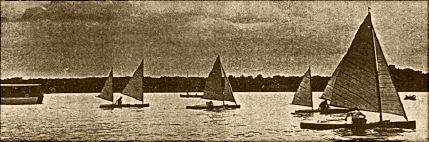 ,
a Brit who spread the IC word through out Europe and Eastern North America
around the turn of the 19th century. The one-design rules of the IC
were adopted using the designs drawn up by Peter Nethercott in 1969.
Roughly every three years the rules are reviewed to determine if changes
should be made to allow new technological developments, though the rules
are fairly open to new ideas.
,
a Brit who spread the IC word through out Europe and Eastern North America
around the turn of the 19th century. The one-design rules of the IC
were adopted using the designs drawn up by Peter Nethercott in 1969.
Roughly every three years the rules are reviewed to determine if changes
should be made to allow new technological developments, though the rules
are fairly open to new ideas.
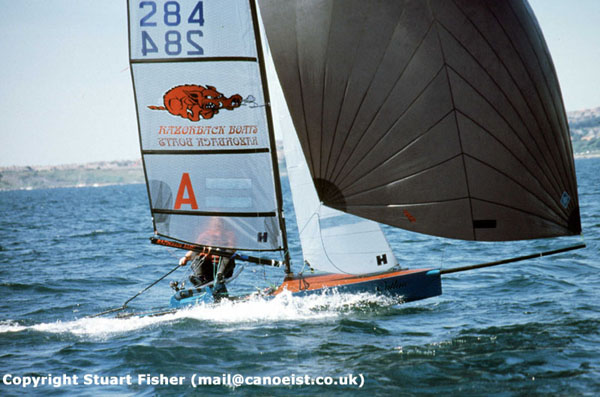 A prime example of this in recent years is the development of the Asymmetrical Canoe (AC) flying a 10 m^2 asymmetrical spinnaker. The IC has a Portsmouth number of 908 putting it on par with the 505 (902), and 29er (924) classes (both double-handed). The AC has a provisional Portsmouth number of 868 putting it on par with the I14 (864) and the RS700 (858, slightly faster) though the AC continues to evolve. This is exceptional considering that all these other boats with the exception of the RS700 are double-handed.
* click the images to see larger versions