
Apparatus
Vacuum pumps used to be fairly easy to come by because companies and the government would throw out ones that were performing below spec. Now-a-days these units are refurbished and put back into service. As a result even used vacuum pumps are very expensive, usually running around $10,000 for the ones I've seen.
A much cheaper solution is to use an air compressor and a Venturi pump.
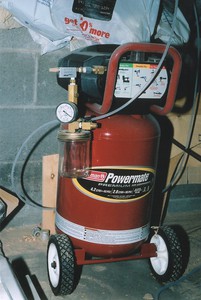
The Venturi pump is an inexpensive block of aluminium or stainless steel that connects to the air compressor output.
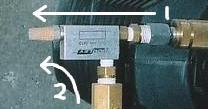
The air flows from the air compressor out the vent in the side of the Venturi pump. [1] This causes air to be sucked up from the bottom hole as it is drawn along with the air flowing past it, much like a perfume bottle. [2] This results in a vacuum at the bottom inlet if not enough air can flow into this inlet because it is connected to something that is sealed, say a bag.
The full vacuum apparatus is show below.
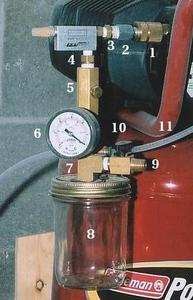
The numbered parts are as follows:
- air compressor quick connect (female)
- apparatus quick connect (male)
- adaptor to smaller Venturi pump pipe size
- same as 3
- check valve
- vacuum gauge (0 to 25 psi)
- T connector
- catcher jar for any epoxy that gets into the lines
- manual release valve
- quick connect T connector to plastic lines (hidden)
- 2 vacuum lines
Apparatus Notes
The check valve [5] doesn't work in my setup, meaning the release valve [9] and T connector [7] are unnecessary. These items are good if the the compressor stops for some reason (for example a power outage), because the vacuum will be maintained to some degree. Its probably not worthwhile though because its very hard to get a bag setup that has no leaks.
The vacuum hose [11] could be split many more times to provide more places where vacuum can be applied, for example in bagging a hull.